Mr Tariff
The last year in Trump Tariff Land

The Supreme Court is expected to issue its opinion in the Trump IEEPA tariffs case in the coming days. This will be big news when it happens, and the Court’s decision will likely be a controversial one however it comes out. And so now seems an appropriate time to do a quick review of the past year in Trump Tariff Land, a truly extraordinary period in US trade history, before we all get too caught up in the SCOTUS controversy.
Readers may recall that while the IEEPA case was being argued in the Supreme Court, the Treasury Secretary—who sat in the courtroom during oral arguments—said that so much money was being raised by the tariffs that it would be practically impossible for the Court to overturn them. An adverse court decision, he said, would “gravely undermine the President’s ability to conduct real world diplomacy…and protect the national security and economy”. The President himself weighed in, saying that the tariffs at issue in the case before the Supreme Court were a “matter of life and death for our country” and warning that the US economy would “go to hell” if the IEEPA tariffs were found to be illegal, an eventuality which he said would be “devastating”.
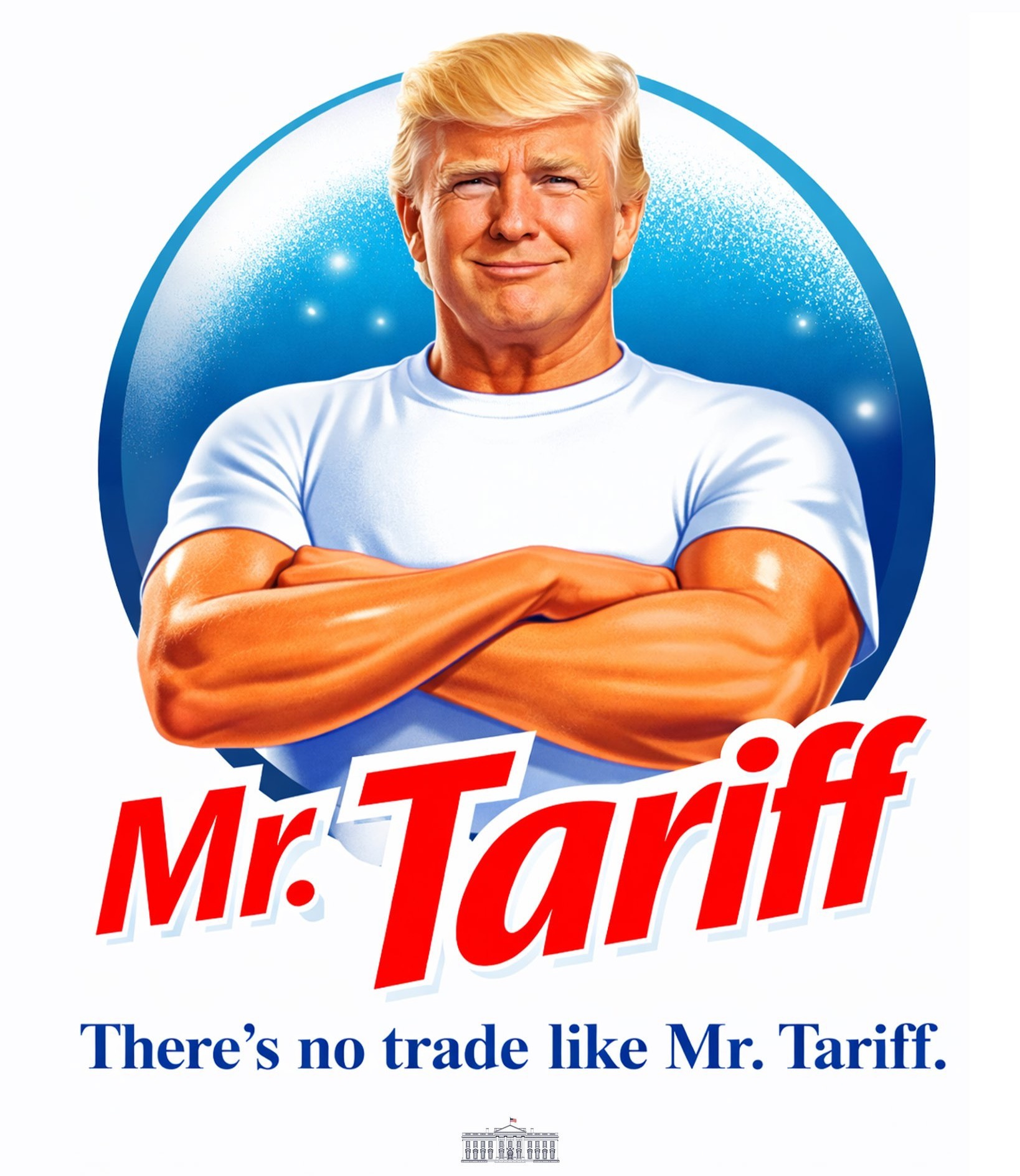
Over the past few weeks, however, the Trump administration has indicated that it is anticipating a defeat of some magnitude in the Supreme Court and is preparing other legal grounds for the tariffs should their IEEPA authority be rejected. But no one from the President on down has suggested that the current level of tariffs will be reduced, regardless of the SCOTUS decision, in fact quite the contrary. And just this week, the White House posted on its website the strange mockup of the President as “Mr. Tariff” (image above), for reasons that are frankly a bit hard to fathom.
When the SCOTUS opinion comes down, I will attempt to put out a quick summary, but in the meantime I have prepared this short refresher for those readers who haven’t been following this story as closely as I have. I have also provided links to my previous B&B posts on this topic, at the end of this post.
Let’s explore.
Mr. Tariff. On April 2nd, 2025, “Liberation Day”, the President of the United States unleashed chaos on the global trading system. With a single stroke of his Executive Order Sharpie, Donald J Trump unilaterally overturned ninety years of US trade policy, announcing unprecedented new tariffs on goods imported from virtually every country in the world. This announcement came just three months after the President had imposed 25% tariffs on goods imported from our closest international trading partners, Mexico and Canada, in violation of his own USMCA free-trade agreement and setting off what the Wall Street Journal called “the dumbest trade war in history”. Over the coming months, the Trump administration would go on to announce a truly head-spinning array of tariff amendments, revisions, reversals and retaliations, at one point ramping up tariffs on Chinese imports to 145% before backing down just a few weeks later. All of which caused not only foreign exporters but also US businesses, farmers and others to throw up their hands in utter confusion and consternation, as they watched their complex supply chains unravel and their expected profit margins disappear.
When Donald Trump first took office in 2017, only 35% of US imported goods incurred tariff charges of any amount, which was about where things stood when he took office again in January 2025. With his April announcement, however, the share of US imports subject to tariff was set to double, to around 70%, before all of the President’s subsequent tariff reversals brought the number down to a still extraordinary 50%. The average rate of tariff charged on imported goods subject to duty is now around 20%, far less than what Trump initially announced in April, resulting in an average effective rate of tariff on all US imports (including goods not subject to duty) of 10% or so.
The economic impact of Trump’s tariffs. An average tariff rate of 10% (on all imported goods) may not seem to most readers like an exceptionally high rate of tariff, but it is the highest rate in effect since the early 1930s (at the time of Smoot Hawley). It also represents a fourfold increase from the rate in effect when Trump took office in January and a sixfold increase from the rate in effect when he took office for the first time back in 2017. Even with this large increase in tariffs, however, the US economy seems to be powering ahead, and we have not yet seen a large macro-economic impact of the Trump tariffs in the way of increased prices, reduced employment and/or lower GDP growth.
And so we must ask, why is this?
Well, part of the explanation is that the Trump tariffs, as implemented, have been far less burdensome that what was initially announced, as noted above. There has also been a lot else going on in the economy other than tariffs, including supportive rate cuts by the Fed and an historical boom in AI spending and investment. But it is also the case that international trade is simply not that large a contributor to the US economy, particularly as compared with export-driven economies like China’s. In fact, 80% of US GDP (and a slightly higher share of US employment) comes from the production of services, with only 10-15% coming from the manufacture of final and intermediate goods, not all of which are subject to foreign competition.
This is not to say that certain sectors of the economy have not been hit hard by the Trump tariffs, because they have. (I am thinking here particularly of manufacturing and agriculture.) Nor is it to say that the prices of imported goods (and goods subject to competition from imports) have not increased markedly as a result of Trump’s tariffs, because they have. But all in all the US economy is holding up well, at least so far, in spite of (not because of) Trump’s tariffs.
Our national trade “emergency”. Readers will recall that President Trump implemented his Liberation Day tariffs in response to what he determined to be a “national economic emergency” in the form of a $1.2 trillion trade deficit (in goods only, “2024), which he falsely characterized as a “subsidy” of the same amount from the United States to foreign countries. According to the President, the continuing American trade deficit is clear and convincing evidence that the US has been getting “ripped off” by every country with which we run a bilateral trade deficit, at least in goods (though apparently not in services, which the President has ignored and where America runs a big trade surplus).
The President’s characterization of trade deficits as a subsidy in the amount of the deficit is economic nonsense, of course, which he may or may not understand but which he clearly wants the rest of us to believe is true. But trade deficits are not evidence of subsidies from importers to exporters, let alone proof that importers are getting “ripped off” by foreign exporters. As Adam Smith taught us 250 years ago, international trade free of governmentally-imposed barriers (like tariffs) generates mutual gains to the benefit of both importers and exporters. Absent government interference, voluntary trade is a classic example of a “win-win” transaction, a concept which our transactional President repeatedly demonstrates that he does not understand.
And it is not even the case that the US trade deficit has exploded in recent years, at least not when measured as a share of US GDP. At ca $1 trillion, the current US trade deficit—which has not (yet) been materially reduced as a result of Trump’s tariffs, other than on a monthly basis—equates to roughly 3% of US GDP. (The deficit is closer to 4% on a goods-only basis.) This is a bit larger than it was a few years ago, but it is in line with much of the past twenty-five years. Since 2000, the annual US trade deficit (goods and services) has ranged from ca 2.5-3.5% of GDP and the deficit for goods only has ranged from 4-5.5% of GDP. If today’s US trade deficit is a national economic emergency, as the President claims, it is one we have been living with for a quarter of a century or more.
“Bring back American manufacturing!” The President has said on numerous occasions that his 2025 tariffs were imposed in order to “defend” and “restore” US manufacturing. But US manufacturing has been declining in the US for quite a long time, as it has been in most other advanced economies. In the US, manufacturing represented almost 30% of GDP in 1950; it was under 20% by the 1980s; and it is now around 10%, where it has been for a decade or so. Manufacturing employment has also been declining during this same period, both in absolute terms and as a share of total employment, in large part as a result of rapid advances in technology, capital investment and worker productivity.
The liberalization of international trade has certainly contributed to these trends—NAFTA was passed in 1992 and China was admitted to the WTO in 2000— but in ways that have generally increased the wealth not only of foreign countries but also of the United States. Not every American worker and consumer has benefitted equally from the expansion of international trade, but we should all resist the urge to measure the economic welfare of the United States solely by the number of Americans working in manufacturing plants.
Trump’s tariff revenues. At their peak levels earlier this year, the Trump tariffs were generating ca $30 billion a month ($360 billion a year) in revenue for the federal government, which Trump administration said at the time would generate $3-6 trillion (cumulatively) of incremental revenue over the next ten years. At these levels, the Trump tariffs represent the largest tax increase in recent US history, although not once have I heard the President refer to his tariffs as what they really are: taxes on the American people.
Tariff revenue is collected by the US government directly from US importers, not from foreign exporters as the President has suggested. And while the ultimate distribution of the economic burden of tariffs is often difficult to measure precisely, recent estimates suggest that more than half of the Trump tariff costs have so far been borne by US businesses (in the form of lower profit margins), with another 30% passed on to US consumers (in the form of higher prices). This leaves only 10-15% of the total cost of Trump’s tariffs to be borne by foreign exporters, who the President told us would pay the entire amount and thereby “make America rich again”.
The legal challenge. Regardless of how important tariff revenue is to the President—and by all accounts it is VERY IMPORTANT—this is not how the Trump Administration has justified the legality of its tariffs before the Supreme Court. According to the US Solicitor, John Sauer, the President’s IEEPA tariffs (which account for over half of total tariff revenue) were intended primarily to regulate trade and reduce deficits, not to raise revenues. Increased revenue, he said, was “only incidental” to the tariffs’ primary policy purpose, and he reminded the Court that if that policy is effective the tariff revenues will decline markedly over time (contrary to White House forecasts).
This distinction between tariffs as a tool for raising tax revenue and tariffs as a tool for regulating trade has a long pedigree in US trade and political history. Not only was this the key constitutional issue at stake in the infamous Nullification Crisis during the 1830s, it may also prove to be determinative of the IEEPA tariff case now before the Supreme Court. The US Constitution grants to Congress, not to the President, the power both to tax and to regulate trade, and while the latter can be (and often is) delegated by Congress to the Executive Branch (within limits), delegations of the taxing power have been harder to sustain in the courts. It remains to be seen how the current Court will characterize the IEEPA tariffs, but if it focuses on the revenue-raising aspects of the tariffs, rather than their regulatory aspects, it may be hard(er) to sustain them.
So much money. How shall we spend it? It Trump’s tariff revenues continue to raise this much money, how will the Trump administration spend it? Well, the President and senior officials in the administration have over the course of the past year told us a number of wildly inconsistent things in this regard. They have said that the money will be used to reduce the federal debt, to replace the income tax, and to support farmers. They have also told us that the money will be used to pay a big dividend to the American people, a proposal which will no doubt be floated again right before the mid-term elections in November. And just today, the President said that the tariff revenue would be used to fund a 50% ($500 billion) increase in the Defense Department budget, while also paying down debt and funding a dividend to “moderate-income Patriots within our country”.
Keep in mind that all of these decisions on taxation and spending are ones which the Constitution has allocated to Congress, not to the Executive Branch. The constitutional separation of powers is a concept which has often been lost on our President, but this is the fundamental issue now before the Supreme Court in the tariffs case. And I encourage you all to stay tuned for further developments.
Until then, I thank you for your attention to this matter.
Links
The Dumbest Trade War in History, B&B, February 2, 2025
Liberation Day, B&B, April 8, 2025
Then the Worst Happens, B&B, October 27, 2025
Supreme Court to Review Trump’s IEEPA Tariffs, November 4, 2025
Super thorough breakdown of the year in tariff policy. The Nullification Crisis parallel is apt, really brings historicl depth to what otherwise feels like pure chaos. Interesting how tariff revenues got repositioned from "incidental" in court arguments to central in budget discussions. One thing i'm still trying to wrap my head around is how manufacturers are absorbing half the cost, seems unsustainable longterm and wonder if there's gona be delayed layoffs once margins get fully squeezed.