"Then the Worst Happens"
Exploring the Trump-Reagan tariff tiff

This post has been revised slightly since it first went out, most notably to add some missing links, including a noteworthy one from Doug Irwin, the trade economist from Dartmouth, whose magisterial work Clashing Over Commerce (2017) is now the definitive history of US trade policy up to the Trump era.
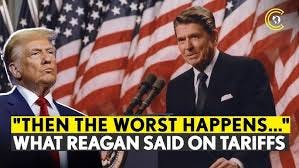
This past week was a rocky one for US-Canada relations and apparently for some Trump supporters, whose fealty to the President is being tested in the wake of a weakening economy, rising prices, continued tariff chaos and most recently a TV ad featuring comments from former President Reagan touting the merits of free trade and the inherent danger of high tariffs. The Reagan comments appeared in an ad run in America by the provincial government of Ontario, consisting of extracts from a 1987 radio address by former President Reagan. In the radio address, Reagan calmly explained to the American people his administration’s continued commitment to the principles of free trade in the context of an escalating trade spat with Japan and growing protectionist pressure from Congress. The ad did not mention President Trump or make any reference to his various tariffs, but the contrast between the two presidents could not have been more stark or more pointed, not only on the substance of trade policy but more importantly perhaps in the clear, thoughtful and dignified way in which Reagan communicated with the American people.
For most of his career, Donald Trump has expressed nothing but disdain for many of the principles that were so important to Ronald Reagan, not only regarding free trade but on other matters as well, including the promotion of democracy abroad, respect for the rule of law, and a vision of America as a “shining city upon a hill” open to “anyone with the will and the heart to get here”.
But something about this particular tariff ad struck a nerve with President Trump. Perhaps it was because the ad was scheduled to run during the World Series, which this year is being contested by a team from Canada (the Blue Jays) and a team from Gavin Newsom’s Los Angeles (the Dodgers). Or perhaps it was because of the continuing influence of Reagan’s legacy on certain members of the Supreme Court, which will soon begin hearing arguments on the legality of large portions of Trump’s tariffs.
But whatever the reason, President Trump responded poorly to say the least. Before game one on Thursday, Trump announced the termination of trade talks with Canada. And after the Blue Jays won with a nine-run sixth inning, which was followed by the ad, he then imposed a punitive 10% increase to his existing Canadian tariffs. Keep in mind that these tariffs are not “taxes on Canada”, as the President likes to tell us; they are taxes imposed on American companies doing business with our closest neighbor and ally. And these taxes have just been increased because of a TV ad which the President of the United States simply did not like.
My social media feed has been inundated over the past several days with outraged comments from MAGA world about the tariff ad, which Treasury Secretary Bessent described as “propaganda” directed “against the American people”. The President himself described the ad as “crooked” and a “fake statement by President Reagan” “created by AI”. Needless to say, the ad was not created by AI and it did not include any “fake” statements from President Reagan. The ad was cropped directly from a short radio address from President Reagan, originally aired in April 1987 in conjunction with an upcoming meeting between Reagan and Japan’s Prime Minister Nakasone to discuss trade issues and other matters. I have listened several times to both the tariff ad and the original radio address, and while I did not find anything in the ad which struck me as misleading or taken out of context, I encourage B&B readers to watch the two videos and form your own views.
More than ten million World Series fans may now have seen the Ontario tariff ad on TV, which also ran during game two but has now been pulled (by the Canadians) for the balance of the Series. And millions more may have seen or become aware of it from social media. The ad has now gone viral, in large part because of the over-reaction of President Trump, who has once again proven to be his own worst enemy. Rather than turning this situation into an opportunity for truly presidential leadership, updating and educating the American people on his latest trade moves (as Reagan did), Trump chose instead to throw a hissy fit, blow up the trade talks with our closest trading partner and pile additional taxes on American businesses and consumers.
I am not sure what else can usefully be said at this time about the Trump-Reagan tariff tiff, but this story is not over and it is far from clear how it will impact the ultimate resolution of our trade dispute with Canada, a dispute which to be clear is almost entirely the making of one man, President Trump. But in the meantime, perhaps we can use this as a “teachable moment” to revisit trade policy during the Reagan administration, to consider the role of the president and Congress with respect to tariffs, and to contrast Reagan’s approach to trade policy with what we are all living through today.
Let’s explore.
Trade economics and politics in the Reagan era. President Reagan took office in January 1980, in the midst of Paul Volcker’s war on inflation. At that time, the US consumer price index was increasing at an annual rate of almost 12% and the Fed had in response raised interest rates to nearly 20%, triggering a severe recession. Over the next several years, the foreign exchange value of the US dollar (trade weighted) increased by 50% in response to high US interest rates and the US trade deficit increased by a factor of six, admittedly off a relatively small base (from $25 billion in 1980 to $160 billion in 1987). US imports continued to grow with the strong dollar, but exports collapsed, and the increased competition from foreign imports translated into growing protectionist pressure from Congress. The Reagan administration responded by increasing tariffs in certain politically sensitive sectors of the US economy, but it also worked hard to resist the growing pressure from Congress for additional tariffs and trade restrictions, most notably with respect to Japan, an important ally and trading partner.
The US economy began to recover from the Volcker recession in 1983 and the value of the US dollar began to rise in 1985, following the Plaza Accord orchestrated by the Reagan administration. These two developments relieved some of the pressure on US producers of internationally traded goods and set the stage for the eventual removal of the Reagan-era trade restrictions in the early 1990s.
The 1980s also witnessed a noteworthy shift in partisan political divisions over trade policy, with the Democratic Party (historically free-trade) becoming increasingly protectionist and the Republican Party (historically pro-tariff) becoming increasingly free-trade. Several years after Reagan left office, his Republican successor George HW Bush negotiated the NAFTA free-trade agreement, which was signed into law in 1992 by the Democrat Bill Clinton over strong opposition from protectionists in his own party. And this bipartisan support for free trade survived largely intact for the next twenty-five years, until Donald Trump took office for the first time in 2017.
Reagan’s 1987 radio address. Readers who have taken the time to listen to Reagan’s 1987 radio address will appreciate the context in which he made it, context which seems to have been lost (or ignored) in the current social media kerfuffle over the Ontario tariff ads. At the time of the Reagan radio address, US trade policy was marked by growing tension not only over rising US trade deficits generally but in particular increasing trade imbalances with Japan, most notably in the tech and auto sectors. In 1986, Reagan had imposed tariffs on Japanese semiconductors in response to alleged unfair trade practices and retaliatory dumping by Japanese companies. The April 1987 radio address was delivered to the nation as President Reagan prepared to meet with Japanese Prime Minister Nakasone in an attempt to reduce trade tensions and to defuse growing protectionist pressure in Congress, with a view to reducing tariffs and expanding international trade, not building a tariff mote around American manufacturers in certain industries.
President Reagan’s imposition of tariffs on Japanese semiconductors was implemented pursuant to clear congressional authority granted to the president under section 301 of the Trade Act of 1974, following a factual finding that Japan had failed to enforce key provisions of the 1986 US Japan Semiconductor Agreement regarding market access for US exporters and the “dumping” of Japanese products into the US. And while the Reagan-Nakasone discussions in 1987 did not generate an immediate change in US policy, it did set the stage for the Reagan administration’s subsequent removal of the restraints on Japanese semiconductor exports over the coming years.
Ironically, around this same time President Reagan also signed into law the 1988 Canada-US Free Trade Agreement, a precursor to NAFTA (1992) and many years later President Trump’s own USMCA (2018). Reagan’s 1987 radio address to the American people may have been specifically about trade relations with Japan, but Canada was very much in the picture then, as it is today.
The role of Congress and the President in trade policy. The US Constitution very clearly empowers Congress, not the President, to impose taxes, including tariffs, and to regulate international trade. Over the past century, however, Congress has delegated to the President limited authority on its behalf to negotiate trade agreements and to levy tariffs. The Reciprocal Trade Agreement Act of 1934 (RTAA) granted to the president, for the first time in US history, conditional statutory authority to levy tariffs and negotiate trade agreements without prior congressional approval. But the authority delegated to the president under the RTAA was limited to making reductions in existing tariffs (not imposing new or increased tariffs), negotiated in exchange for reciprocal concessions (not retaliations) from our trading partners. And this presidential authority was by statute limited in duration and conditioned upon subsequent congressional approval (in an up-or down vote, with no possibility of amendments dictated by Congress).
The RTAA of 1934 was effectively superseded by the Trade Act of 1974, signed into law by President Ford who took office after President Nixon resigned to avoid the embarrassment and civic discord of his own impeachment over Watergate. Section 201 of the Trade Act authorizes the president to impose temporary tariffs or quotas on imports which threaten serious injury to domestic industries. Section 232 authorizes the president to levy tariffs or impose quotes on imports which threaten national security. And Section 301 authorizes the president to impose tariffs in response to foreign unfair trade practices. In each case, the statutory delegation of trade authority to the president is limited either by time (duration) and/or by various procedural requirements (eg a formal investigation by the USTR and compliance with WTO obligations). During both his first and second terms in office, President Trump has relied on Section 232 (national security) for his steel, aluminum and auto tariffs and on Section 301 (unfair trade practices) for some of his tariffs on China and other countries.
A large portion of Trump’s tariffs have been imposed on the basis of other more questionable legal authority, most notably the International Emergency Economic Powers Act. IEEPA was signed into law by Jimmy Carter in early 1978, and delegates to the president limited authority during national emergencies to impose economic sanctions, trade restrictions and/or financial controls. In contrast to the Trade Act, however, the statutory text of IEEP{A does not expressly grant to the president the power to levy tariffs, the relevance of which will be determined by the Supreme Court in litigation challenging the President’s Liberation Day “reciprocal” tariffs and his “fentanyl” tariffs imposed on China, Mexico and Canada.
Is Trump’s trade policy consistent with that of President Reagan? In recent days, President Trump has suggested, without any apparent sense of irony or contradiction, not only that former President Reagan was in fact a high-tariff guy like himself but also that he and President Reagan were at heart free-traders who have levied tariffs for the sole purpose of driving better trade agreement outcomes for the US and US exporters. To accept that Donald Trump and Ronald Reagan were of one mind when it comes to tariffs and trade policy, however, one would have to more or less ignore everything that has been said or done in the matter of trade policy by these two very different presidents.
Ronald Reagan was by all accounts (other than Trump’s) a committed free-trade advocate for more or less his entire political life, and as president he made this clear even when he levied tariffs on foreign goods in response to particular trade concerns, as for example with Japanese semiconductors in 1987. Donald Trump. on the other hand, has long been a committed proponent of high tariffs and protectionist trade policy, and there is little evidence that he views his extraordinary tariffs as a purely temporary measure to be employed in the pursuit of free trade and low tariff outcomes. And while Ronald Reagan imposed his tariffs pursuant to very clear statutory authorization from Congress, we cannot say the same thing about a large portion of Trump’s tariffs, most notably his “reciprocal” tariffs announced on Liberation Day, which now apply to virtually every country in the world.
What is Trump really trying to accomplish with his tariffs? At various times, President Trump has said that the primary goal of his tariffs is to reduce US imports and eliminate bilateral US trade deficits, to raise large amounts of incremental tax revenue for the federal government, to make American manufacturing “great again”, to put an end to illegal immigration and drug trafficking, to extract large investment commitments from foreign companies and governments, and to promote US foreign policy interests which often have little or nothing to do with international trade per se.
And I for one think we should take the President at his word. Donald Trump really does want to do all of these things, as inconsistent as some of these goals may be. He simply wants to do it all, and to do so without input or constraint from the US Congress, the administrative state, the courts, state or foreign governments, the press, or for that matter public opinion. Donald Trump views US tariff policy as a tool for expanding and exercising his power as President of the United States, whether or not that power has in fact been constitutionally delegated to the president by the Constitution or by Congress. In his mind, the power of the president to levy tariffs should operate like the power to grant pardons, completely immune from challenge by Congress or the courts, even (or particularly) when that power is used to achieve questionable or corrupt ends.
Reagan’s legacy, and Donald Trump. President Reagan did not always live up to his principles, in matters of trade policy or otherwise, and what we now understand as the Reagan legacy does not always bear close resemblance to what actually happened or how it was viewed at the time. But to his credit, Ronald Reagan always made great show of his respect for the office of the presidency and for the constitutional limits on the power of that office. And by all accounts Reagan was a true believer in the benefits of limited government, low taxes, free markets and free trade, even if specific policies of his administration were not always entirely consistent with those principles
Needless to say, these are not the traits which come most immediately to mind when one thinks of our current President, who seems to have found very little of value in the Reagan administration other than its campaign slogans, which he has now transformed beyond recognition to those of us who remember Reagan’s own “morning in America”.
Over 77 million Americans voted for Donald Trump in 2025, up from 74mm in 2020 and 63mm in 2016. And many of those who voted one or more times for Donald Trump also purport to revere the legacy of Ronald Reagan. I myself have never fully understood how this is possible—to worship Ronald Reagan while voting for Donald Trump—but I suppose it has something to do not only with the poor alternatives offered up by the Democratic Party but also with the amazing ability of human beings to sublimate even deeply held beliefs which happen to conflict with whatever it is they want to do at the moment.
But what do Reaganites really think about the Reagan legacy and how it has been transformed by Donald Trump? There aren’t many senior officials from the Reagan administration still alive today, but the most notable survivor is almost certainly David Stockman, who became Reagan’s OMB director in 1981 at the tender age of 34. David Stockman was for Ronald Reagan what I suppose Russell Vought is today for Donald Trump, and he was very definitely “in the room when it happened” on a large range of matters, including trade and tariff policy. I have spent a lot of time reading and thinking about David Stockman, who I follow actively on social media. And I think it is entirely fair to say that Stockman is no fan of the Trump administration’s tariff policies or of the President himself, whom he considers to be a reckless threat to American solvency and the future of our free-market economy.
Until recently, the Republican Party held itself out proudly as the party of Ronald Reagan, but it has now very clearly become the party of Donald Trump. Tens of millions of Americans welcome this change, as apparently do the vast majority of Republicans now sitting in Congress, who seem unable or unwilling to challenge anything which President Trump does or says, however outrageous it may be. As a lapsed Reagan Republican myself, I find this hard to accept, but if this is in fact the case then perhaps MAGA Republicans shouldn’t be quite so upset by a TV ad which simply points out that Donald Trump is no Ronald Reagan
And if this is not the case—if the spirit of Reagan is still very much alive in today’s Republican Party, despite all evidence to the contrary—then now may be the time for these folks to screw up some courage and get back in the game. And when they do, I for one hope they will go out and win one for the Gipper.
Links
Reagan vs Trump on Tariffs, WSJ Editorial Page, October 26, 2025
Will Trunp’s Tariffs Survive SCOTUS ‘Major Questions’ Test? NY Times, October 27, 2025
No, Ronald Reagan Didn’t Love Tariffs, Paul Krugman Substack, October 27, 2025
The Canadians Were Right about Reagan and Trade, Doug Irwin NY Times, October 29, 2025
I am so embarrassed by his actions without thought. Comparison to Reagan is apples and oranges.....