Clashing Over Commerce, Part Three
Trade disputes fuel sectional conflict and crisis

This is Part 3 of our series on the history of US trade policy, based primarily on Doug Irwin’s book, Clashing Over Commerce (2017).
In Part One of this series, we discussed international trade and British trade policy during the period of America’s founding, from the settlement of Jamestown (1607) to the Declaration of Independence (1776). In Part Two, we continued this narrative into the period of the American Revolution, the post-war years under the Articles of Confederation, and the early years of the new Republic. And in today’s post we will look at trade policy from the War of 1812 to the election of Abraham Lincoln and the brink of the Civil War (1861).
Let’s explore.
Aftermath of the War of 1812. As discussed in our last post, US trade with the rest of the world collapsed spectacularly during the administrations of Thomas Jefferson (1801-09) and James Madison (1809-1817). This was in large part the result of explicit foreign policy decisions taken by those administrations in response to British provocations, most notably Jefferson’s disastrous trade embargo (1807) and Madison’s declaration of war with Britain. In both cases, US international trade came largely to a standstill, not only with Britain (still our largest trading partner) but also with France and other nations, with significant adverse impacts both on US economic activity and revenue flows into the US treasury.
The War of 1812 was finally settled in 1815, with neither side a clear victor and without resolution of the specific trade and navigational disputes which formed the core of the American casus beli. International trade with the United States rebounded quickly after the war, despite the decision of the Madison administration and Congress to increase tariffs to then-unprecedented levels. The Tariff of 1816 was adopted primarily for the purpose of raising revenue to pay for the war, but it also included a number of specific duties intended to protect domestic manufacturing interests from foreign competition, the first quasi-protectionist tariff in US history. But the protectionist features of the Tariff of 1816 did not emanate so much from a reversal of Republican free-trade ideology as from the lobbying of Congress by American manufacturers, whose businesses had sprung up during the many interruptions of foreign trade (and the absence of foreign import competition) in the Jefferson and Madison administrations.
This would not be the last time in US history that tariff policy was effectively dictated to Congress by special interest groups, but the effects would prove to be particularly consequential over the coming years. The Tariff of 1816 added fuel to the fires of growing sectional conflict, pitting the economic interests of northern manufacturers directly against those of southern agricultural exporters. And once set ablaze, these fires of sectional conflict would prove very hard for Congress to contain in the years to come.
Henry Clay’s American System. A Virginia native who later moved to Kentucky, Henry Clay was one of the most prominent national politicians of the first half of the 19th century, and his impact on US trade policy was profound. Clay became Speaker of the House during his first term in office (1811-13), where he and other congressional “war hawks” pushed President Madison into declaring war with Britain, the War of 1812. Clay later served in the Senate and became known as the “Great Compromiser”, brokering not only the Missouri Compromise of 1820 but also the Compromise of 1850, both seminal pieces of federal legislation which attempted to defuse the nation’s growing sectional conflict over the spread of slavery into the new territories. Though out of office at the time, Clay was also a prominent critic of the Mexican-American War, as was the freshman Congressmen from Illinois, Abraham Lincoln. Clay ran unsuccessfully for president on four separate occasions, in 1824, 1832, 1840 and 1844, initially as a National Republican, the anti-Jackson wing of the old Jeffersonian Democratic-Republican Party, and later as a Whig, the party which shortly after Clay’s death (in 1852) morphed into the Republican Party, largely in response to passage of the Kansas-Nebraska Act (1854).
Henry Clay is known today for many things, but for our purposes we will focus on his contributions to US economic and trade policy. Clay’s “American System” was a nationalist program of infrastructure projects (roads, bridges, canals, etc) funded with protectionist federal tariff revenue. As Speaker of the House, Clay orchestrated the necessary congressional support for his program by soliciting votes from both the western states (who benefitted most from the infrastructure projects) as well as from the northern manufacturing states (who favored protectionist tariffs), overriding strong and often strident opposition on both counts from the southern agricultural states, whose voting power in the House of Representatives continued to wane with the shift of population to the northern and western states in the 1820s and 1830s. (One of the reasons the southern states fought so hard for the expansion of slavery into the new territories was to defend their voting power in Congress, particularly in the Senate.)
The Tariff of Abominations. The disputed presidential election of 1824 was one of the seminal political events of the first-half of the nineteenth century. A four-way race including Henry Clay, John Quincy Adams and Andrew Jackson resulted in Jackson winning a plurality of the electoral votes, but not an outright majority, which for the second and last time in US history required that the election be decided in the House of Representatives. (The election of Thomas Jefferson over Aaron Burr in 1800 had also been decided in the House.) Despite a weak showing in the general election, John Quincy Adams was able to secure the necessary votes in the House, but only after Henry Clay and Daniel Webster threw him their support, with Clay being appointed Adam’s Secretary of State in what was decried at the time as a “corrupt bargain”.
Four years later, the 1828 campaign for president was a rematch between Adams and Jackson. Adams continued to draw most of his support from the pro-tariff North and was strongly in favor of Clay’s American System of federal infrastructure projects funded with protectionist tariff revenue. He was also a strong supporter of the Second Bank of the United States, which had been chartered by Congress in the final year of the Madison administration (1816). (A previous Republican Congress had let the charter for the First Bank of the United States expire in 1811, one year before declaring war on Britain.) Jackson drew most of his support from the South and he was a firm believer in states rights, although also a staunch Unionist. Jackson was strongly opposed to Clay’s American System, although not as firmly committed to low and non-protectionist tariffs as many of his supporters would have liked. Jackson famously hated the Second Bank of the United States, which as president he successfully killed off, letting its charter expire in 1836 and setting the stage for the Panic of 1837, a financial crisis which decimated the US economy and once again collapsed international trade.
In the run-up to the presidential election of 1828, a divided Congress passed what at the time was the most protectionist tariff bill in US history, the Tariff of 1828, which became known in the South as the “Tariff of Abominations”. The Tariff of 1828 was not only highly protectionist of northern manufacturing, it also increased the average rate of tariff on dutiable imports to over 60%, a particular problem for the agricultural exporting states of the South. (High tariffs increase the cost of imported goods, and in doing so they not only reduce the volume of imports but also effectively constrain the volume of exports.) How the Tariff of 1828 made its way successfully through Congress during an election year remains one of the mysteries of nineteenth century political history. But in the end the bill was passed by both the House and the Senate and was signed into law by President Adams in May, six months or so prior to the election. The Tariff was deeply unpopular in the South and it became a major issue in the campaign, contributing to Jackson’s large margin of victory over Adams.
The Tariff of 1828 helped put Jackson in the White House, but it later created major problems for him as president. At that time, political opposition to the Tariff of 1828 was concentrated primarily in the southern states, most notably South Carolina, and that opposition would come to be led by Jackson’s own Vice-President, John C. Calhoun. (Calhoun had also served as VP under Adams.) By the end of 1828, Calhoun had resigned from the office of Vice-President to take a seat in the Senate on behalf of South Carolina, where he became a leading figure in the nullification movement, a serious threat not only to the supremacy (and uniformity) of federal law under the Constitution but also to the very survival of the Union itself.
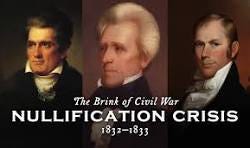
The Nullification Crisis. Calhoun spoke for many in the South when in July of 1828 he called the Tariff of 1828 “unjust, unconstitutional and oppressive”. At that time Calhoun was still serving as Vice-President under John Quincy Adams, who signed the tariff bill into law, and he feared that passage of the law would weaken the continued commitment of the southern states to maintain the Union. While serving as VP, Calhoun anonymously drafted the document known at the time as the South Carolina Exposition, and later as the “Calhoun Exposition”. In his Exposition, Calhoun articulated the principle of constitutional “nullification”, which laid the intellectual foundation for the ensuing Nullification Crisis of 1832-33.
In Calhoun’s view, and in the view of many southerners, the US Constitution authorized Congress to impose tariffs only for the purpose of raising revenue, not for the protection of particular industries. But Calhoun also went one step further, asserting that under the principle of “nullification”, individual states retained the right not to enforce federal laws which they found to be unjust or unconstitutional, including in this case tariff laws. This may seem to contemporary Americans like an odd take on the supremacy of federal law under the Constitution, but we should keep in mind that the events we are discussing took place just forty-five years after the ratification of the US Constitution, at a time when the understanding of the constitutional limits of federal and state authority was still very much in flux, much more so than is the case today. (We might also reflect upon our own recent experience, in which both red and blue states have at times refused to recognize the supremacy of federal law in their own jurisdictions, for example in the matter of civil rights or immigration.)
For the next four years, the southern states fought hard in Congress to repeal or revise the Tariff of 1828, an effort which was only partially successful with the modest reduction of rates embedded in the still-protectionist Tariff of 1832. In November of 1832, South Carolina passed the “Ordinance of Nullification”, which declared the Tariffs of 1828 and 1832 “null and void” and which threatened to secede from the Union if the federal government attempted to enforce the tariffs in the state. The next month, President Jackson issued his own “Proclamation to the People of South Carolina”, in which he declared the principle of nullification unconstitutional and threatened federal military action to enforce the tariffs. Congress followed up in February of the following year by passing the “Force Bill”, authorizing the president to use military force to enforce federal law in South Carolina.
And so by March of 1833 the federal government and the state of South Carolina stood toe to toe on the brink of a constitutional crisis, federal military action and the secession of South Carolina from the Union. But in a last minute deal brokered by Henry Clay (who else?), Congress defused the situation by passing yet another tariff law, known as the Compromise Tariff of 1833, which legislated very large reductions in tariff rates over a ten-year period. The new tariff schedule provided a period of transition for northern manufacturing interests and also a way for South Carolina to save political face, which it did (sort of) by repealing its Ordinance of Nullification but then invoking a largely mute nullification order with regard to Jackson’s Force Bill.
Antebellum trade policy and the road to civil war. There are of course many parallels between the Nullification Crisis of 1832-33 and the path to secession of South Carolina and the other southern states after the election of Abraham Lincoln as president in 1860. The Nullification Crisis did not lead inexorably to southern secession and civil war, although it no doubt contributed to that eventuality and was an important historical in its own right. For the most part, the antebellum period in American history was dominated by issues other than trade policy, including western expansion, the Mexican-American War, the annexation of Texas, and of course slavery. But sectional conflict over tariffs was nevertheless an important part of the story.
The gradual reduction in tariff rates provided for in the Compromise Tariff of 1833 took effect as scheduled from 1833-41, a period in which the low-tariff Democrats retained unified control of the federal government. But political pressure for a change of government and increased tariffs began to grow in the wake of the Panic of 1837 and during the economic contraction which followed.
The protectionist Whig Party retook control of Congress after the election of 1840, but had some initial difficulty implementing its high-tariff legislative agenda due to the unexpected opposition of the President, John Tyler. Tyler was a former Democrat from Virginia (Charles City), who was elected as part of the “Tippecanoe and Tyler Too” ticket with the Ohioan William Henry Harrison (also a Charles City native), who unexpectedly died after just one month in office. Tyler may have run with Harrison as a Whig, but when it came to tariff policy, he was decidedly a low-tariff Democrat at heart.
Despite his personal hostility to high and protectionist tariffs, Tyler agreed to sign into law the Tariff of 1842, known in the South as the “Black Tariff”, which reintroduced protective duties and increased the average rate of tariff from 26% in 1842 to 37% by 1847. In passing this legislation, the Whig-controlled Congress effectively tore up the legislative compromise brokered by Henry Clay in 1833, in the process ripping open the high-tariff wounds previously inflicted on the South, which once again felt betrayed, but this time by one of their own.
The Democrats took their political revenge on the Whigs in the election of 1844, which pitted the Democrat JK Polk against the perennial Whig candidate Henry Clay. The election of 1844 was more of a referendum on the annexation of Texas than on the question of tariffs, but in any event it proved to be a clean sweep for the Democrats. This was also the first national election in which the competing parties issued formal “platform statements” outlining their views on key issues, including of course tariffs. The Whig platform reaffirmed the Party’s support for high protective tariffs, while the Democratic platform opposed “discriminatory” tariffs and supported a minimal tariff for revenue purposes only.
After regaining unified control of the federal government, the Democrats passed yet another new tariff law, the fifth major tariff bill in less than a decade. The Walker Tariff of 1846 reversed the tariff rate increases passed by the Whigs in 1842, but rather than providing for a gradual reduction in rates (as in previous bills) it cut rates immediately. The Walker Tariff remained in effect for over a decade, largely because until 1861 no party other than the Democrats had unified control over the federal government. The Whig Zachary Taylor was elected president in 1848, and while both he and his successor Millard Fillmore (also a Whig) attempted to increase tariffs, the Democratically-controlled Congress simply ignored them, as was its prerogative.
By 1860, it seemed that the Democrats had largely won the political battle over tariff policy. With their passage of the Tariff of 1857, the Democrats had reduced the average rate of tariff on dutiable imports from over 60% in 1830 to around 20% by 1858, up to then the lowest rate in the nineteenth century.
Everything changed after the election of Abraham Lincoln as president in 1860, however, due in large part to the subsequent secession from the Union of seven southern Democratic states. From 1861-1875, the Republican Party retained firm control over both Houses of Congress as well as the White House. Trade policy was not front and center during most of this period, but tariffs remained a matter of great importance both to the states and to the federal government, initially as a means to raise revenue and secure supplies during (and after) the War and then as a core component of Republican economic policy, from 1865 into the early 20th century.
And this is where we will pick up the story in our next post.