Clashing Over Commerce, Part Two
Trade policy in the new Republic

This is Part Two of a series on the history of US trade policy, sourced largely from Doug Irwin’s excellent book, “Clashing Over Commerce”.
In Part One of this series, we discussed British trade policy from the founding of Jamestown (1607) to the signing of the Declaration of Independence (1776). In that post, we noted the critical importance of international trade to the American colonies and examined the increasing tension over trade policy which arose between Britain and the colonies in the wake of the Seven Years War, leading up to the outbreak of hostilities and the American declaration of economic and political independence from Britain.
In today’s post, we will begin where Part One left off and look at trade and trade policy during and after the War of Independence and in the early years of the new Republic, through Jefferson’s trade embargo and the War of 1812.
Let’s explore.
International trade during and after the War of Independence. The rebellious American colonies quickly discovered that declaring their new nation independent of British control and open to trade with the rest of the world was far easier said than done. No other country formally recognized the independence of the United States until France did so in 1778, and few were willing to risk trading with the former colonies in the face of the continuing British blockade. As a result, international trade with the new nation ground to a near-halt during the war, decimating the economy, crippling the rebels’ war effort and threatening the cause of American independence.
The colonists’ rebellion effectively ended with the victory over Cornwallis at Yorktown in 1781, after which many Americans expected a quick recovery in international trade. Unfortunately, this was not to be. During peace negotiations in 1782-83, Britain seemed initially inclined to relax its trade restrictions on the United States, before reversing course after a change in government in 1784. The new government displayed little appetite for granting trade concessions to its former colonies and instead shut off US trade with the British West Indies. The closure of the West Indian trade threw the US balance of trade into a large deficit, draining the new nation of hard currency and causing both deflation and a severe recession, with New England (shipping) and the Southern States (agricultural exports) hit particularly hard.
In 1785, the United States sent John Adams to London and Thomas Jefferson to Paris to negotiate new trade agreements with the British and the French. After several years of effort, the American envoys failed to secure trade agreements with either country, each of whom understood that the US federal government did not have legal authority under the Articles of Confederation to impose tariffs or make trade agreements on behalf of the thirteen sovereign States. And without tariffs as a source of revenue, the new US federal government found it difficult to raise money in the credit markets, leaving it reliant on ad hoc funding requisitions from the states, who rarely paid up in full or on time.
Serious efforts to reform the Articles began in 1782 and continued for the next several years, but the states were never able to achieve the required unanimous consent. The United States may have won its independence from Britain on the battlefield, but under the Articles of Confederation the federal government was rendered effectively insolvent and with no clear path to financial viability or economic independence.
Trade authority under the new Constitution. By 1787, the manifest impotence of the US federal government operating under the Articles of Confederation cast serious doubt upon the continued existence of the Union, with New England threatening to secede if the problems were not soon addressed. And it was not just representatives from New England who were distraught at the inability of the federal government to regulate international trade and impose tariffs. “Most of our political evils can be traced to our commercial ones”, said James Madison in a 1786 letter to Thomas Jefferson, in which he made the case for revising the trade and tariff provisions of the Articles of Confederation in order to secure the future of the Union. And so it came to pass that representatives of the thirteen states met in Philadelphia in May of 1787 to begin drafting a new constitution.
According to Irwin’s account of the Constitutional Convention, the state delegates quickly and without much debate agreed to grant Congress the power to impose “duties, imposts and excises”, with taxes on trade widely regarded at that time as the only feasible way for the new federal government to raise the revenue needed to “pay [its] debts and provide for the common defense and general welfare”.
Somewhat more controversial was the proposal to make this tariff power exclusive to the federal government, and take it away from the states. But this too passed in short order, albeit with more debate and a closer vote.
Most controversial of all was the proposal to grant the federal government the power to regulate trade, which in this context meant the authority to impose trade regulations other than tariffs, most notably navigation laws. The New England states wanted to empower the federal government to grant financial preferences to American ships in the transport of goods into and out of US ports. But the Southern states strongly opposed such preferences, which they feared would reduce competition and raise shipping costs for their agricultural exports. The Southern states proposed to require a two-thirds vote in Congress to approve any such regulatory policy, a demand which the New England states would not accept. This seemingly intractable sectional conflict was ultimately resolved through what Irwin calls the “dirty compromise”, one of many such unsavory compromises in American political history. The Southern states agreed to give up their demand for a super-majority vote on trade regulation in exchange for a constitutional prohibition of all taxes on exports and a twenty-year ban on federal regulation of the slave trade.
Finally, the Convention delegates agreed that all future treaties would require the consent of two-thirds of the Senate. This provision was intended at least in part to preserve the states’ ability to block unpalatable trade provisions in presidentially-negotiated treaties, such as the infamous Jay-Gardoqui Treaty (1786). This treaty, had it been approved, would have opened US navigation to Spain and its colonies, a boon for New England shippers, but at the cost of granting Spain exclusive rights to navigate the Mississippi River, a critical transport link for states in the south and the west.
The Tariff Act of 1789. The Constitutional Convention adjourned in September 1787, having finished its work, and the proposed new Constitution was sent out for ratification by each of the thirteen states. After much debate, ratification was finally achieved in June 1788 with the approval of New Hampshire, the ninth of the thirteen states which eventually voted to approve the new Constitution.
The newly-formed Congress of the United States met for the first time in April 1789, and among the first items to come before it was a bill proposed by James Madison to levy duties on imports for the purpose of raising much-needed revenue for the US Treasury. The bill proposed the imposition of an 5% ad valorem tariff on all imports and higher specific tariffs on selected items, with a small list of duty-free goods. Irwin estimates the blended average tariff rate in Madison’s bill at around 12%, a figure which was not particularly controversial at the time, and which was subsequently raised to 20% or so by the mid-1790s.
The Tariff Act of 1789 was signed into law by President Washington on the 4th of July, a particularly appropriate date given the near-fatal blow to American independence caused by the inability of the federal government to regulate trade and impose tariffs under the Articles of Confederation.
The great debate over trade policy. The Tariff Act of 1789 was designed primarily to raise revenue for the nearly bankrupt US Treasury, and for that reason the bill’s sponsors wanted the bill to pass into law quickly. But when the bill came before Congress, Madison could not prevent his colleagues from engaging in several months of what Irwin calls “the great debate over trade policy”, or what a cynic might less charitably call “the first wave of special-interest lobbying in the new Congress”.
What should be the primary purpose of tariffs? Is it to raise revenue? To restrict imports and thereby protect domestic industry from foreign competition? To provide for national security and the national defense? Or should tariffs be regarded simply as tactical bargaining chips to be used in negotiating trade agreements and extracting some measure of policy reciprocity from other nations? And how do tariffs fit into the bigger picture of trade regulation and navigation rights?
Congress debated these issues on several occasions in the early years of the new Republic, during which the US tariff schedule evolved gradually to meet the increasing revenue needs of the federal government. Underlying this rather mild debate over tariffs, however, was a fundamental disagreement between the states and their representatives in Congress as to the role which trade and commerce should play in the economic development of the new nation, a disagreement which over time would become increasingly heated and would come eventually to threaten once again the unity of the new nation.
The Founding Fathers and Adam Smith. Most of the Founding Fathers would likely have considered themselves at least in principle to be advocates of free trade, along the lines proposed by Adam Smith, whose book The Wealth of Nations was first published in 1776. The Founding Fathers were products of the same Enlightenment thinking which produced Adam Smith, with whose work they were quite familiar. But they were also practical men who lived and worked in a world where taxes on trade were considered to be the only feasible way to raise large amounts of government revenue. The eighteenth century was also a world in which the major European trading powers (Britain, France and Spain) operated large colonial empires founded on mercantilist principles. And because these governments provided commercial and financial preferences to their own domestic industries, the Founding Fathers generally agreed (to varying degrees) that the United States must do the same, at least initially.
With memories of the War of Independence still very fresh in their minds, the Founding Fathers were also keenly aware of the importance of trade policy to national defense. As stated by Madison, “each nation should have within itself the means of national defense independent of foreign supplies”. As stated, this view was widely shared at the time, although it tended to be interpreted somewhat differently in the maritime, commercial and manufacturing states of the north than it was in the agricultural south.
At the request of Congress, Alexander Hamilton, then the Secretary of the Treasury in the Washington administration, submitted to Congress in December 1791 the final draft of his now famous Report on the Subject of Manufactures, promoting various policies (tariffs, trade restrictions and subsidies) to accelerate the development of domestic manufacturing, in part for reasons of national defense. Hamilton’s recommendations were for the most part not acted upon by the incumbent Congress, but his report remains a classic in the trade literature with perspectives that remain topical and insightful even today.
To the Founding Fathers, “free trade” did not mean a world with no tariffs; nor did it mean equal treatment of domestic and foreign shippers. But they did envision a future world where the barriers to trade would be kept to a minimum and where liberalized trade and trade reciprocity among nations might lead not only to increased commerce and wealth for the benefit of all, but also more peaceable relations among nations and fewer costly wars. At least this was the hope, which as we will see was quickly dashed to pieces during the presidential administration of perhaps the biggest free-trader of them all, Thomas Jefferson.
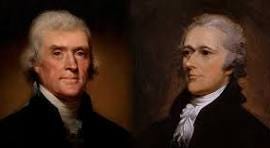
Jefferson and Hamilton face off. Theater-goers will recall from the play Hamilton the “cabinet battles” fought during the Washington administration between the Federalist Alexander Hamilton and the Republican (then Democratic Republican) Thomas Jefferson. [Watch the two debates here and here.]. These debates concerned Hamilton’s plan to assume the states’ war debts and establish a national bank, and Jefferson’s proposal to ally the US with France in its war with America’s principal trading and financial counterparty, England. The Hamilton-Jefferson debates reflected not only disagreements about the specifics of public policy but also two very different visions of the future development of America: one urban and commercial with a strong federal government allied with Britain (Hamilton) and the other rural and agrarian with a weak central government allied with France (Jefferson).
Hamilton won the first round of debates, but his economic and political philosophy did not initially survive Jefferson’s election as President in 1800. And for that matter, neither did Hamilton himself. In July 1804, Alexander Hamilton—one of the truly great figures in early American history (and on the modern stage)—was shot and killed in a dual by Jefferson’s sitting Vice-President, Aaron Burr, who somehow escaped murder charges only to be tried later for unrelated acts of treason.
The Jefferson Embargo. Thomas Jefferson took office as president in 1801, after the one-term presidency of Washington’s successor, John Adams. In his inaugural address, Jefferson had the temerity to state that “We are all Republicans; we are all Federalists”, after years of criticizing the policies of his Federalist predecessors (even while he served in the Washington administration), and before proceeding with his Republican allies in Congress to stoke what Irwin describes as “stark partisan divisions” over trade and foreign policy.
The Jefferson administration abolished the unpopular internal excise tax, leaving the US Treasury entirely dependent on volatile tariff revenues which could and would be disrupted at times of international conflict, of which there would be many in the years to come. Republican rhetoric took a hard line against the perceived indignities of British trade policy, but the Jefferson administration failed diplomatically to resolve these disputes, leaving the US on the brink of yet another war with its former colonial master.
In June of 1807, the British navy fired on the US warship Chesapeake off the course of Norfolk. Despite growing calls for immediate military retaliation, Jefferson pursued instead what he termed a strategy of “peaceable coercion”. The President called on Congress to impose a total embargo on all American exports, not only to Britain but also to other foreign nations as well. Describing his embargo as “the last card we have to play, short of war”, Jefferson’s embargo resolution was approved by the Republican-controlled Congress in a highly partisan vote. But it did not end well.
Jefferson’s embargo proved to be not only ineffective in bringing Britain to the negotiating table—the British had little difficulty finding other markets for their exports and other sources for their imports—but also disastrous for the American economy. Jefferson’s embargo quickly brought to a halt not only US exports but most US imports as well. (Few foreign ships would bring goods to the US if they would have to make the return trip empty.) As a result, customs revenue collapsed and the US economy fell into a deep depression, in what Professor Irwin describes as “the most dramatic, self-imposed shock to trade in US history”. At the time, the Republican John Randolph of Virginia—a fierce Jefferson critic and perhaps the first “RINO” in American political history— described Jefferson’s trade policy as “a series of the most impolitic and ruinous measures, utterly incomprehensible to every rational, sober-minded man”.
The War of 1812. Largely as a result of Jefferson’s embargo, the Republicans suffered big losses during the election of 1808. Despite the losses, however, they were able to maintain control of Congress and hold on to the White House, with James Madison elected to succeed Thomas Jefferson as president. By the time Madison took office in early 1809, the Republican-controlled Congress had repealed Jefferson’s universal embargo, only to replace it with a ban on trade with Britain and France (and their colonies). This opened US trade to the rest of the world, but US trade flows did not increase to anywhere near pre-embargo levels, leaving the US economy still in a weakened state.
Over the coming years, Republican trade policy continued to have significant ramifications for the party (and the nation) as a new generation of Congressional Republicans took office. Led by Henry Clay (Kentucky) and John Calhoun (S. Carolina), the so-called” War Hawks” viewed America’s continuing struggles with Britain not as mere commercial disputes but rather as threats to American sovereignty and honor, which demanded a more muscular response from the United States. The War Hawks found growing political support in the Deep South and in the frontier states, among people hurt by the low market prices for agricultural products and keen to expand into the lands occupied by Indian tribes (who continued to receive British support). Henry Clay called for a push to seize Canada as a means to redress past injustices inflicted upon America by the British while others wanted to take Florida from Spain, in what John Randolph called a “scramble for plunder”.
In the end, the War Hawks got their war. In June of 1812, President Madison called on the Republican-controlled Congress to declare war on an unsuspecting Britain, which at the time had its hands full with the French (in the Napoleonic Wars). Congress approved the declaration of war in a highly partisan and sectional vote, but the war did not go well for the United States. And once again Republican trade policy proved disastrous for the US economy.
In July of 1812, Congress doubled all import duties, imposed additional surcharges and tonnage duties on foreign ships arriving at US ports, continued the ban on British imports and restricted exports to Canada (on goods which might be trans-shipped to Britain). And in December 1813, Congress reinstated the complete embargo on all foreign trade (not just with Britain), forcing US ships to remain in port. Meanwhile the Royal Navy blockaded the entire east coast, from Long Island to New Orleans, initially leaving an opening for shippers from the Federalist states in New England who were willing to transport contraband goods to England. As a result, international trade fell to the lowest level in US history, with the possible exception of during the War of Independence.
By the spring of 1814, the Republican-controlled Congress had largely thrown in the towel, repealing its various embargo and non-importation laws, but to little avail. Britain had by this time defeated Napoleon (who was off to Elba) and was able to shift more of its forces across the Atlantic to fight the Americans, no longer with one arm tied behind its back. The Royal Navy extended its blockade to New England and was able to sail up the Potomac River unmolested and burn both the White House and the Capitol, while President Madison and his cabinet fled for safety, leaving Dolly Madison behind to collect the White House silver.
In December 1814, the two sides decided to call it a day and signed a peace agreement, which as Irwin notes restored the status quo ante bellum without addressing either British impressment or neutral nation shipping rights, the ostensible reasons America went to war.
And it is in memory of these events that we celebrate today with the singing of our national anthem before every sporting event, an occasion which always leaves me with the eerie feeling that my team is about to get trounced, as did the United States back in the War of 1812.
Jefferson sees the light. It is tempting to say that little good came out of this last period in US history, from Jefferson’s embargo to the end of the War of 1812, but as Professor Irwin points out, this is not quite right. As a result of the massive disruption to international trade caused by maritime conflict, Republican trade policy and war, US domestic manufacturing finally took root, ironically supported by the high-tariff policies of the supposedly ‘free trade’ Madison administration. By the end of the War of 1812, the United States now had three legs to its economic stool--commerce, agriculture and manufacturing--as envisioned two decades earlier by none other than Alexander Hamilton.
By 1816, it seems that even Thomas Jefferson, no longer in power, had come around to Hamilton’s way of thinking about trade, although I doubt he would have characterized it in quite these terms. Readers will recall that it was Jefferson who in 1785 had lauded America’s yeoman farmers as the “chosen people of God” and who called for “our workshops to remain in Europe”. According to Irwin, however, Jefferson eventually came to appreciate the importance of domestic manufacturing not only to the American economy but to the American experiment in self-government. “Experience has taught me”, said Jefferson, “that manufactures are now as necessary to our independence as to our comfort”. Which of course is exactly what Hamilton had been saying all along.
Thomas Jefferson’s conversion notwithstanding, 1816 did not mark the end of the partisan political battles over US trade policy. Far from it. Within just a few years, the US would experience growing sectional conflicts over tariffs and trade policy, once again threatening the unity of the new nation and this time setting the nation inexorably on the road to civil war.
Absolutely loved this deep dive into Jefferson's trade policy train wreck. The connection betwene the embargo's failure and the accidental birth of American manufacturing is kind of wild. I always knew the War of 1812 was a mess but didnt realize just how self-inflicted the economic damage was from Republican policy. What really got me was that final Jefferson quote admitting Hamilton was right all along, takes a lot to admit that after decades of ideological warfare.